
An image that dramatizes and communicates an idea presupposes the use of a visual language. Just as people can ‘verbalize’ their thinking, they can ‘visualize’ it.
What?
A diagram, a map, and a painting are all examples of uses of visual language. Its structural units include line, shape, color, form, motion, texture, pattern, direction, orientation, scale, angle, space and proportion.
The elements in an image represent concepts in a spatial context, rather than the linear form used for words. Speech and visual communication are parallel and often interdependent means by which humans exchange information.
The London Underground map
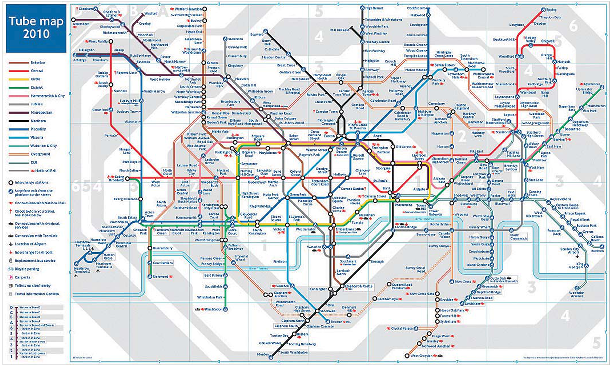
Developed by engineer Harry Beck, it’s one of the most famous maps in city transport. Beck used color to differentiate lines, so that people could readily identify the right route. The map is schematic i.e. it’s a simplified diagram that uses abstract graphic elements (lines) to represent a complex real-world situation. This most original of designs is a model copied in various forms throughout the world, including the Paris and New York City metro systems.
The London Underground map has to be the most iconic use of a visual language that has truly stood the test of time, its simple use of colour, lines and space is what peeked my interest.
References:
Visual_language. (2014, March 13). Retrieved January 5, 2015, from wikipedia: http://en.wikipedia.org/wiki/Visual_language
Dabner, D., Calvert, S., & Casey, A. (2012). The New Graphic Design School A Foundation Course in Principles and Practice. Wiley.
Image Reference:
brandnatter. (2012, September 19). Your County, Your Way – Monmouthshire County Council. Retrieved January 5, 2015, from hband.co: http://hband.co/2012/09/19/your-county-your-way-monmouthshire-county-council/